- Is your brand visible in those AI generated answers?
- What CMOs are really trying to solve
- A quick note on expectations
- The main categories of AI visibility tools
- Tools focused on brand presence in AI answers
- Tools designed for discovery and learning
- Tools that look more like SEO tracking
- What these tools still cannot do
- How CMOs should actually use AI visibility tools
- Questions worth asking before you invest
- Let’s wrap this up
AI visibility tools: a practical guide for CMOs and heads of marketing

“I hope you enjoy this blog post. If you want our B2B digital experts to help you smash your targets, click here.”
What will I learn?
- Is your brand visible in those AI generated answers?
- What CMOs are really trying to solve
- A quick note on expectations
- The main categories of AI visibility tools
- Tools focused on brand presence in AI answers
- Tools designed for discovery and learning
- Tools that look more like SEO tracking
- What these tools still cannot do
- How CMOs should actually use AI visibility tools
- Questions worth asking before you invest
- Let’s wrap this up

AI search is no longer a side conversation.
Your buyers are asking questions in ChatGPT, Gemini and Perplexity.
They’re getting answers before they ever reach your website.
That raises a fair question.
Is your brand visible in those AI generated answers?
This is where AI visibility tools enter the picture.
If you’ve looked at this space already, you’ll have noticed something else.
There are a lot of tools coming onto the market. Very little clarity.
This guide is here to help you cut through that.
No testing rabbit holes.
No feature-by-feature charts.
Just a clear view of what these tools do, where they help, and where to be careful.
What CMOs are really trying to solve
Before we talk tools, it’s worth grounding this in the real problem.
Most CMOs I speak to are not asking:
- How do I rank number one in ChatGPT?
They are asking:
- Is our brand being referenced at all?
- Are we part of the conversation in our category?
- Are competitors showing up when we are not?
- Is AI changing where awareness is built?
AI visibility tools can help answer those questions.
They cannot replace strategy.
Keep that lens in mind as we go.
A quick note on expectations
AI search does not work like Google.
There are no stable rankings.
There is no consistent query set.
Responses change based on prompts, context and model updates.
So these tools give signals, not certainty.
Used well, they support better decisions.
Used badly, they create noise.
The main categories of AI visibility tools
Most tools in this space fall into three groups.
Understanding the difference matters more than the brand name.
Tools focused on brand presence in AI answers
IThese tools help you understand whether your brand is being mentioned when AI systems respond to category-level questions.
Otterly.ai
Otterly tracks brand mentions across large language models.

What it’s useful for:
- Seeing whether your brand appears in AI-generated answers
- Spotting gaps where competitors are named and you are not
- Tracking changes over time at a high level
What to be careful with:
- Treating it like rank tracking
- Assuming visibility equals demand
This works best as an awareness signal.
Peec.ai
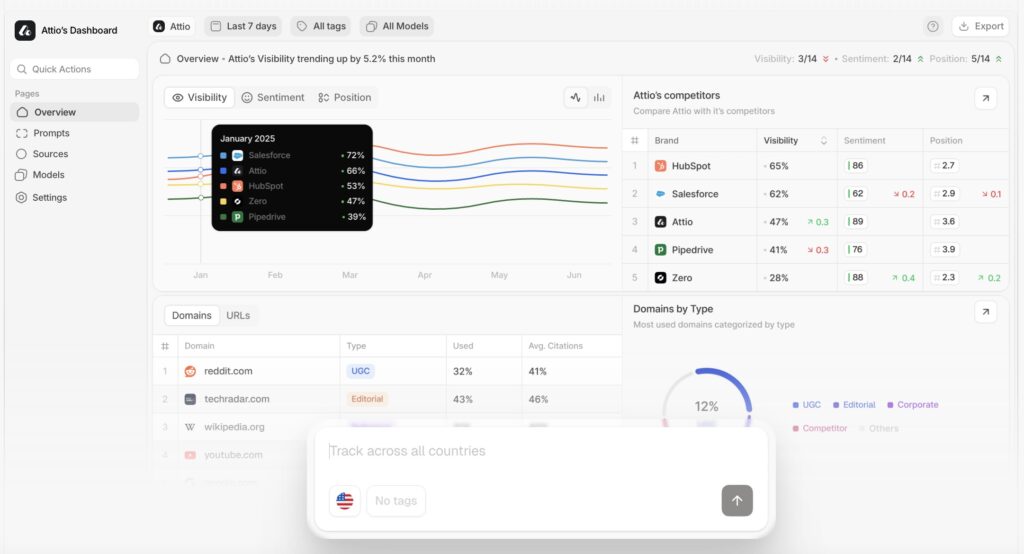
Peec leans towards clearer reporting and internal sharing.
What it’s useful for:
- Giving marketing leaders a digestible view of AI visibility
- Supporting conversations with leadership teams
- Tracking trends rather than individual queries
This is closer to something a CMO can review monthly rather than daily.
MyBrandi.ai
MyBrandi looks at how brands are described, not just whether they appear.
What it’s useful for:
- Understanding brand narrative in AI responses
- Checking consistency of how your business is framed
- Supporting reputation and messaging work
This is more about perception than traffic.
Tools designed for discovery and learning
These tools help you understand how AI systems surface content and brands, rather than tracking performance.
LLM Listed
LLM Listed acts as a directory of brands and products referenced by AI systems.
What it’s useful for:
- Category discovery
- Early-stage research
- Understanding who appears in AI-driven recommendations
It’s not a reporting tool.
Think of it as market scanning.
Searchable
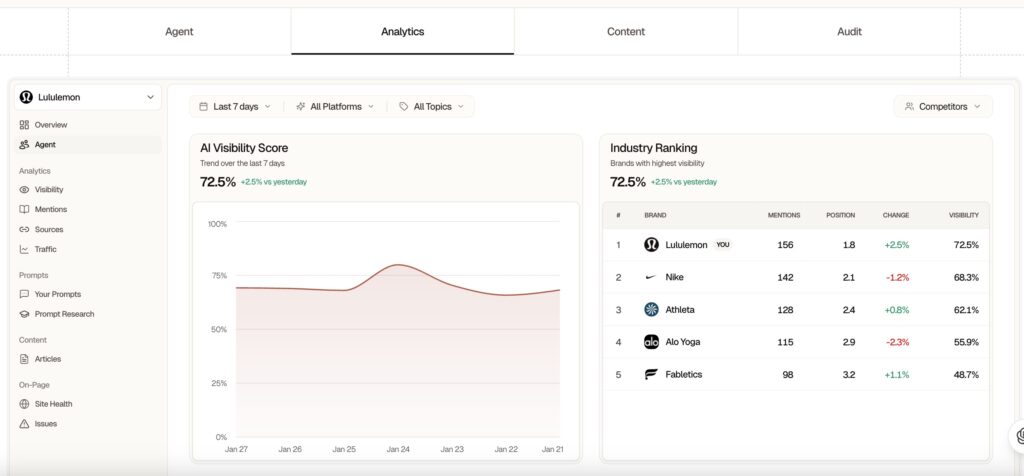
Searchable focuses on how content is retrieved and cited by AI tools.
What it’s useful for:
- Strategy discussions
- Understanding content patterns
- Educating teams on how AI pulls information
This supports thinking.
It does not replace measurement.
Tools that look more like SEO tracking
These tools try to bring familiar SEO logic into AI search.
Trakkr.ai
Trakkr attempts to monitor positions or presence for defined prompts.
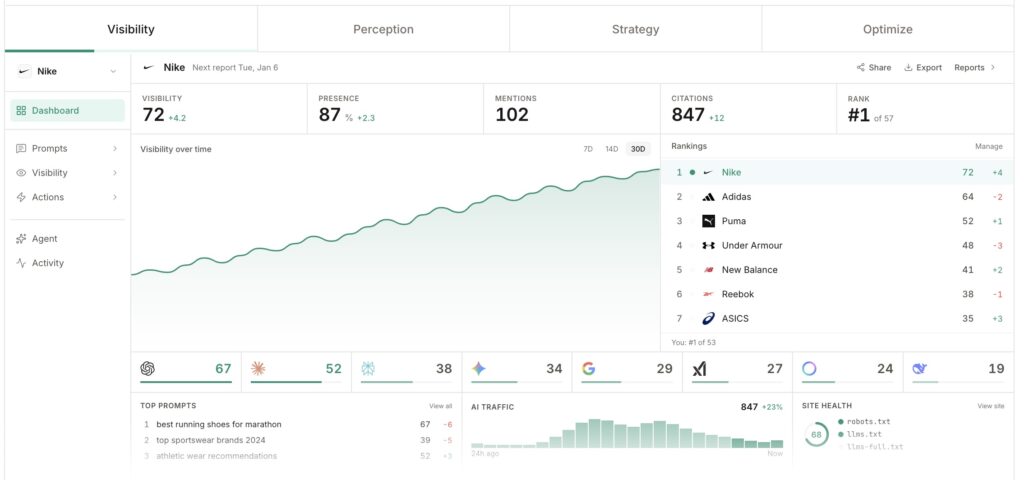
What it’s useful for:
- Testing hypotheses
- Supporting SEO team experiments
- Monitoring specific branded prompts
What to watch:
- Over-interpreting movement
- Reporting “rank changes” to the board
AI does not reward mechanical chasing.
What these tools still cannot do
No AI visibility tool can:
- Prove attribution
- Predict pipeline impact
- Replace brand building
- Replace demand creation
- Fix weak positioning
If your brand lacks authority, clarity or presence today, AI will reflect that.
AI systems pull from:
- Recognised brands
- Trusted sources
- Consistent coverage
- Credible citations
Tools can highlight the gap.
They cannot close it for you.
How CMOs should actually use AI visibility tools
Used well, these tools support smarter decisions.
Here’s where they earn their place.
- Sense-check brand presence outside Google
- Identify awareness gaps early
- Support content and PR planning
- Pressure-test whether your category leadership is visible
Here’s where they do not belong.
- Weekly performance reporting
- Board-level KPIs
- Isolated SEO activity
- Panic-led rework
AI visibility should sit alongside:
- SEO performance
- Digital PR signals
- Brand demand
- Sales feedback
Not above them.
Questions worth asking before you invest
Before you trial any tool, ask yourself:
- What decision will this help me make?
- Who will review it internally?
- How often will we act on the data?
- What will we stop doing if we add this?
If you can’t answer those clearly, wait.
Let’s wrap this up
AI visibility tools are not the next SEO platform.
They are early signals of where attention is shifting.
For CMOs and Heads of Marketing, the value sits in:
- awareness
- positioning
- category presence
Not in chasing scores or rankings.
If you want help:
- sense-checking your AI visibility
- understanding what competitors are doing well
- connecting AI search back to content, PR and demand
That’s a conversation worth having.If this guide helped you think more clearly, message me.
If you’re already testing these tools, I’d love to hear what you’re seeing.
About Beth
Beth is an experienced B2B SEO specialist with 25 years in marketing across various sectors. As a Chartered Marketer certified by the Chartered Institute of Marketing, she blends her traditional marketing expertise with modern tactics to achieve excellent online results for our clients.